TL;DR
- You can sell AI-generated art when three separate checks pass: tool commercial-use permission, sales-channel rules, and no third-party rights infringement.
- U.S. copyright law generally does not protect purely AI-generated outputs; human-authored additions, selections, and edits in the same file may qualify.
- Adobe Firefly non-beta outputs are cleared for commercial use under Adobe’s terms; beta features and partner models carry separate, different conditions.
- Midjourney and ChatGPT image tools grant commercial rights on paid plans; Midjourney adds separate conditions for businesses above a revenue threshold, while OpenAI paid plans do not impose a revenue-threshold condition, though content policy restrictions apply across all tiers.
- Document every project with a prompt log, edit history, tool plan screenshot, and marketplace disclosure before you publish or invoice.
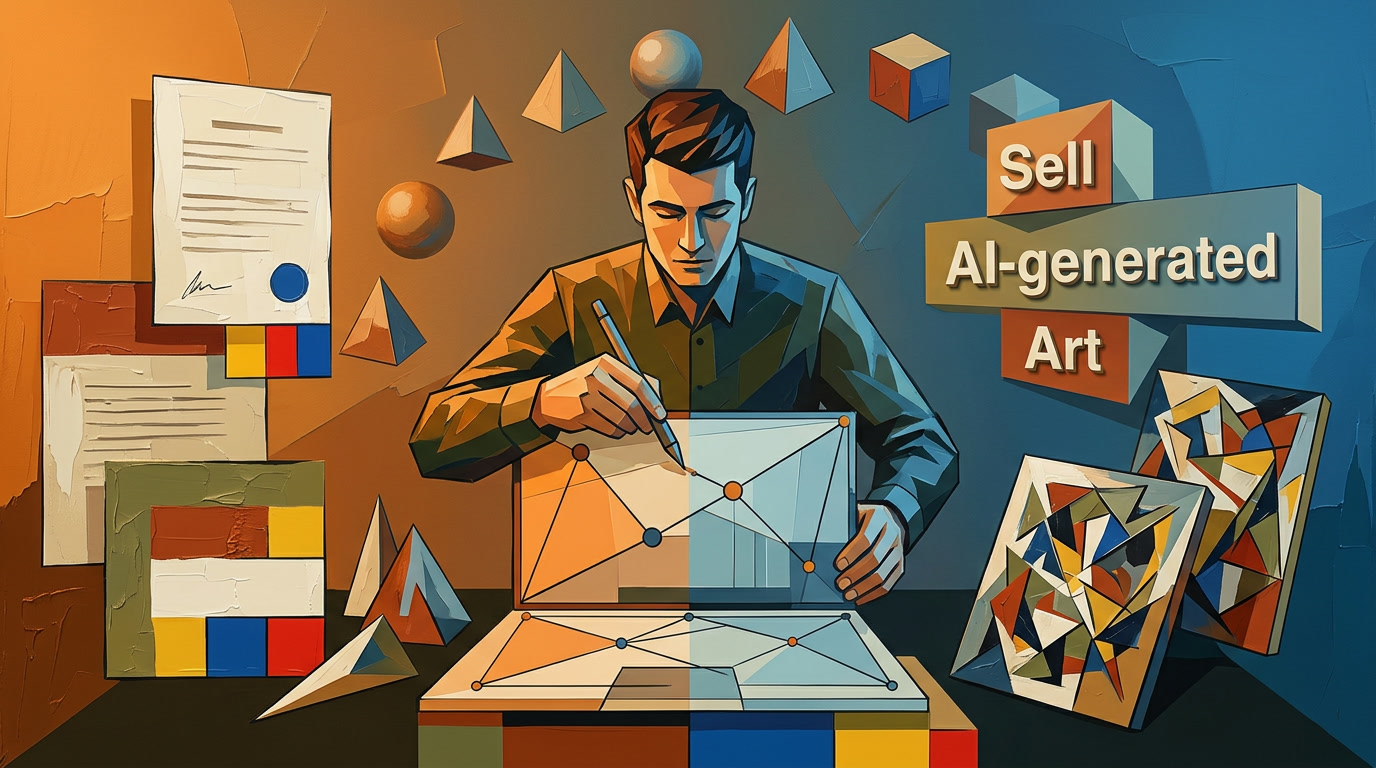
Can you sell AI-generated art? Yes, in many situations, but that yes has a checklist attached. Three separate legal layers apply to every AI image you plan to sell, and collapsing them into one question is the most expensive mistake a freelance designer can make. This article breaks all three down in plain English using a decision framework you can run before the invoice goes out.
Can You Sell AI-Generated Art Legally?
Selling AI-generated art is legal in most jurisdictions when three conditions are met: the tool’s terms of service permit commercial use for your subscription tier, the sales channel allows AI content, and the image does not infringe on copyright, trademarks, or rights of publicity held by third parties. All three must pass independently.
Definition: An AI-generated image is any visual output produced primarily by a machine-learning model in response to a user prompt or input, without substantial human authorship in the image’s direct creation.
The right to sell something and copyright protection are different legal questions. You can sell a work that carries no copyright protection, the same way you can sell a print of a 19th-century painting. You just cannot stop others from copying it. For one-off client deliverables, that distinction matters less. For stock assets, logo files, or templates meant to stay exclusive, it matters enormously, and the contract must reflect the difference.
What Are the Three Gates Every Designer Must Clear Before Selling AI Art?
Every AI image sale requires passing three sequential gates. Clearing Gate 1 does not open Gate 2, and clearing both does not automatically clear Gate 3.
Gate 1: Tool license. The tool’s subscription plan must permit commercial use. Free tiers often do not. Paid plans commonly do, but some tools restrict resale of raw outputs, limit use in advertising, or impose revenue-based conditions on commercial sellers. Check the terms for your exact plan and check for updates, because tool providers revise their terms more often than most designers notice.
Gate 2: Sales channel. The marketplace, stock site, or client contract must allow AI-generated content. Many platforms now require disclosure, and some categories have strict rules about what counts as “designed by” the seller. Requirements vary and are still evolving across all major platforms.
Gate 3: Third-party rights. The image must not infringe on anyone else’s rights. A tool’s commercial-use permission does not shield you from trademark infringement, claims based on training-data content, or violations of a person’s right of publicity. If the output looks substantially like a recognizable brand element, logo, or living person, it needs review before it goes near a product listing.
What Does U.S. Copyright Law Say About AI-Generated Images?
The U.S. Copyright Office position is clear: copyright protects human authorship, and when an AI system produces an output without sufficient human creative input, it generally cannot qualify for copyright protection under U.S. law. The official framework is published at copyright.gov/ai.
The Copyright Office’s Part 2 Copyrightability Report on AI states that prompts alone typically do not establish the kind of human authorship the law requires. The report does, however, recognize that human-authored expression within an AI-assisted work may qualify for protection. Original elements a designer drew, composited, arranged, selected from many candidates, or substantially modified can qualify, though the protection covers those human contributions specifically, not the AI output underneath them.
Practically: typing a prompt into Midjourney or Adobe Firefly produces a raw image unlikely to receive U.S. copyright protection. When you select that image from dozens of variations and add post-processing, retouching, typography, and layout, that combined work may become protectable. Copyright covers only the human-authored portions. The AI output underneath remains unprotected regardless of how much time spent on the prompt.
Copyright rules also vary internationally. The World Intellectual Property Organization notes that member countries set their own standards for authorship and originality, so a work that attracts no U.S. copyright may receive different treatment in the EU, UK, Canada, or Australia. Sellers who operate cross-border should check jurisdiction-specific guidance before making ownership claims to clients or on product listings.
Key Takeaways
- Purely AI-generated images are unlikely to qualify for U.S. copyright protection; original human-authored contributions layered on top may create protectable expression in those specific elements.
- The three-gate check (tool license, sales channel, third-party rights) must be run for every image, every project, and every platform independently.
- International rules differ: a U.S. copyright gap does not automatically apply in every country where you sell.
- A prompt log, source files, edit history, and tool plan documentation are your evidence of creative contribution when a client or marketplace asks questions.

Which AI Tool Plans Permit Commercial Use: Adobe Firefly, Midjourney, and ChatGPT?
AI tool policies differ substantially by plan tier, and the tool’s name alone does not determine what you can sell.
Adobe Firefly. According to the Adobe Firefly Generative Credits FAQ, outputs from Firefly features not labeled beta can be used in commercial projects. Beta outputs may also be commercially usable unless the product interface states otherwise, though those eligible beta outputs may not carry the same indemnification protection available on standard features. Partner models integrated into Adobe apps carry separate license conditions and may not share the same commercial-use grants as native Firefly outputs. Always check which model generated a specific output, especially in Photoshop’s generative tools.
Midjourney. Midjourney’s paid plans grant commercial-use rights for most outputs. Midjourney’s Terms of Service include separate conditions for companies above a revenue threshold, so studios or agencies that are larger commercial operations should verify the applicable tier requirements in the current Midjourney Terms of Service directly. The free or trial tier does not grant commercial use.
ChatGPT image generation via OpenAI. OpenAI’s usage policies for paid consumer plans (Plus, Pro, and Team) generally permit commercial use of generated images, subject to their content policy. Free-tier outputs carry more restrictions and are not cleared for commercial sale. Enterprise accounts operate under a separate agreement that includes stronger IP indemnification terms covering copyright claims, a protection not extended to standard paid consumer tiers. The ChatGPT consumer product and the OpenAI API are governed by different agreements, so any studio or agency accessing image generation through the API rather than the ChatGPT interface should review the API-specific usage policies directly. Unlike Midjourney, OpenAI does not impose a separate revenue-threshold condition on commercial image use for paid plan subscribers, though content policy restrictions apply across all tiers and certain image categories are prohibited regardless of plan. The current version of the terms governs, not summaries published months ago.
One rule that applies across all three tools: a commercial-use license means you have permission to sell the output. It does not transfer copyright to you, and it does not indemnify you against claims brought by third parties based on the content of the image itself, such as trademark or likeness claims.
What Are the Marketplace, Stock Platform, and Client-Work Rules for Selling AI Art?
Clearing the tool license is Gate 1. Gate 2 is the sales channel, and requirements vary significantly by platform type.
Etsy. Etsy’s seller policy requires that items you sell as “handmade” or “designed by” you meet specific criteria about your direct creative involvement. AI-generated designs used in print-on-demand products are permissible in many cases, but Etsy requires accurate disclosure of production methods and prohibits misrepresenting a design’s origin. Failing to disclose AI involvement when Etsy asks is a policy violation. Category-specific rules for genuinely handmade goods may be stricter than general merchandise rules.
Stock platforms. Major stock sites, including Getty Images and Shutterstock, have announced varying policies on AI-generated content, with positions that continue to shift. Many platforms either prohibit AI-generated submissions outright, require disclosure and special tagging, or offer a separate AI content track with different royalty structures. Check the current contributor guidelines for any stock platform before uploading a single file.
Client deliverables. When delivering AI-assisted work to a client, the contract is the most important document. The contract should specify what tools were used, that the work includes AI-generated elements, what rights the client actually receives (a license to use versus a full copyright assignment), and who carries liability if a third-party claim arises after delivery. Avoid warranting copyright ownership of elements that are not protectable under current law.
Print-on-demand. Services like Redbubble and Printful generally permit AI-generated designs under standard seller agreements, subject to their content policies. Some require disclosure in product descriptions. The more practical risk is content moderation: designs that closely resemble existing characters, brand assets, or celebrity likenesses are removed quickly and can lead to account suspension, regardless of what the AI tool’s terms permit.
Frequently Asked Questions
- Can you sell AI-generated art without copyright protection on the image?
- Yes, copyright and the right to sell are separate legal questions. A tool’s commercial-use license grants permission to sell the output even when no copyright protection exists. Without copyright, anyone else can also copy and sell the same image. For general print-on-demand designs this is a manageable risk; for exclusive client assets or brand identity work, it is a material gap that the contract should acknowledge directly.
- Does a commercial-use license from an AI tool mean I own the copyright?
- No. A commercial-use license is permission to sell outputs; it is not a copyright transfer. Copyright in AI-generated content, to the extent any exists, stays with the tool provider under their own terms or remains legally unprotected. What a designer can own is the copyright in human-authored contributions: original drawn elements, layout decisions, typographic design, and compositing choices that reflect creative judgment rather than the model’s output.
- Are AI-generated images automatically public domain?
- Not through any formal public-domain designation, though the practical effect in the U.S. is similar for purely AI-generated portions. The U.S. Copyright Office has consistently held that works lacking human authorship cannot be registered or enforced as copyrighted works. That is distinct from a work formally entering the public domain through expiration, but the result for a buyer or competitor is much the same: the raw AI output can generally be reproduced without copyright liability, though trademark and other non-copyright claims can still apply.
- Can I use AI-generated art in a client’s logo or branding project?
- Tool terms often permit AI use in logos on paid plans, but the ownership picture requires a candid conversation with the client. A logo built primarily on an unprotectable AI output cannot be exclusively owned by the client as a copyright matter. Trademark registration can still protect the logo as used in commerce, which covers many brand needs in practice. Combining AI-generated elements with original human-drawn work creates a composite where the human contributions are protectable. Disclose the AI involvement in the contract, limit any warranty of copyright ownership to human-authored portions, and run a trademark search on the final mark before delivery.
- How much human editing makes an AI-generated image eligible for copyright protection?
- The Copyright Office evaluates human authorship case by case without a fixed editing threshold. What matters is whether genuinely creative human decisions are reflected in the final work: original drawn elements, meaningful compositional choices, deliberate selection from many generated candidates, or substantial modifications that go beyond simple cropping or filter application. Courts will continue to develop this standard over the coming years. The practical approach is to document every creative decision thoroughly and treat human-authored contributions as the protectable asset, rather than the AI output those contributions build on.